WalletMobile appIn progress
Your identity, in your hand. Nowhere else.
The Aegis wallet holds the credentials a person has earned and presents them at a counter or online — one fact at a time, approved with their face or passcode, signed by a key that never leaves their phone’s secure hardware.
One tap at a counter. One approval online.
Prove an age in person over ISO/IEC 18013-5, open an account online over OpenID4VP, or approve a payment with the transaction bound into the signature.
Runs entirely in your browser.
Scenarios
Present in person
Show this to the readeror hold the phone to it
Waiting for a reader
Channel
In person · no network needed
ISO/IEC 18013-5 · QR or NFC → Bluetooth
The reasoning
A shop must know the person is old enough. Must it see their name, their birth date, or their document?
- EngageThe wallet shows a code, or the phone is tapped to the reader. That engagement carries the reader into a secure session over Bluetooth.
Built so the wallet cannot betray its holder.
A native app over one protocol core, shared with the platform’s own issuer and verifier tests.
- Keys in hardware
- Private keys are generated and used inside the phone’s secure hardware, with hardware key attestation, and never enter the app’s memory.
- In progress
- Every use approved
- Each presentation needs the person, by face or device passcode.
- Built
- Collect
- Receive credentials over OpenID4VCI from Aegis or any conformant issuer.
- Built
- Present online
- OpenID4VP, cross-device and same-device; registering as a credential provider with the phone, so a browser can ask the wallet directly.
- In progress
- Present in person
- ISO/IEC 18013-5 over QR or NFC engagement and Bluetooth, with the reader authenticated before the radio answers.
- In progress
- Transaction binding
- For approvals, the key signs exactly the transaction shown; change the payee or the amount and the signature fails.
- Built
- Status at use
- A credential’s status is checked when it is used, failing closed.
- Built
- Backup without values
- A backup that holds no credential value, kept in the phone platform’s end-to-end encrypted store.
- In progress
- No telemetry about you
- The wallet sends Aegis no personal value — no claims in logs, analytics or crash reports — and Aegis never learns where a credential was presented.
- Built
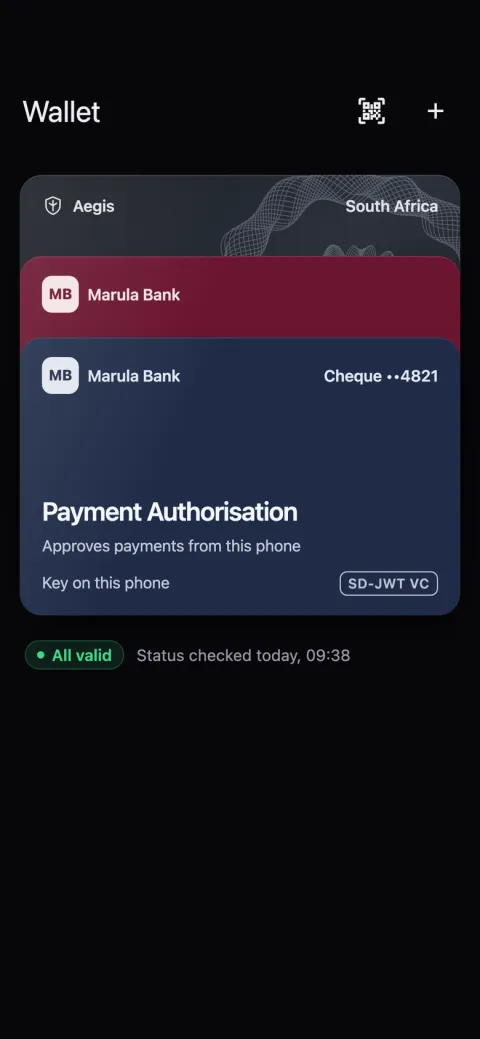
The wallet
Credentials held on the phone, their status checked at a glance.
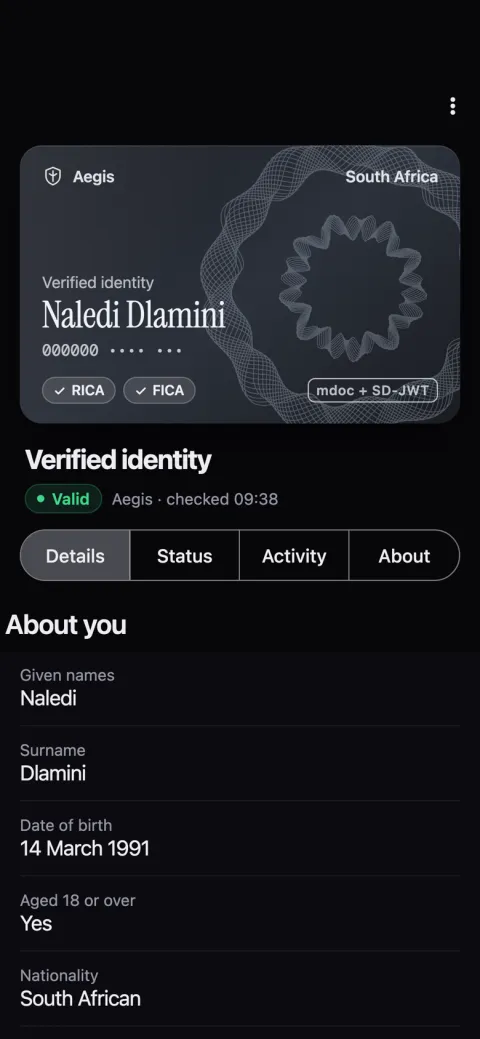
A credential
A verified identity in mdoc and SD-JWT VC, with every claim and its checks.
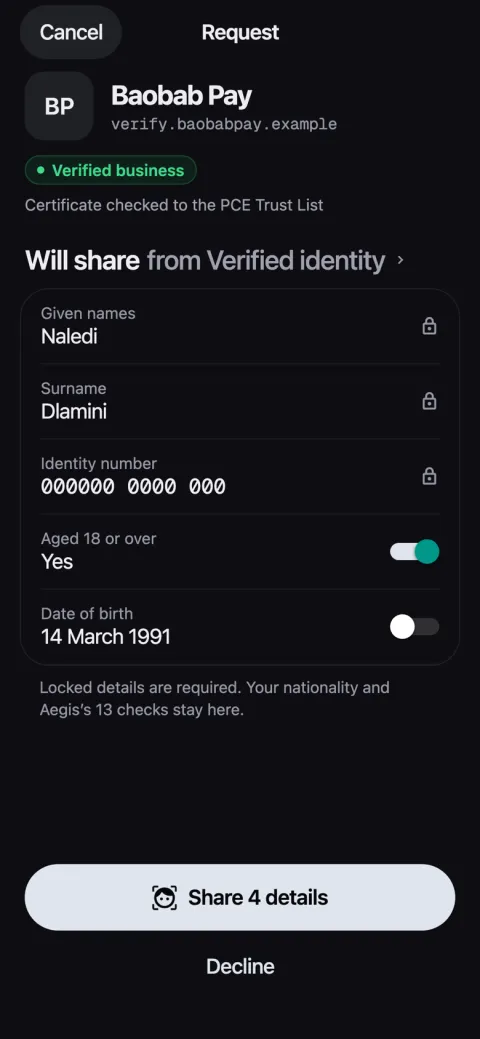
A request
A verified business asks; the person sees what leaves the phone and switches off the rest.
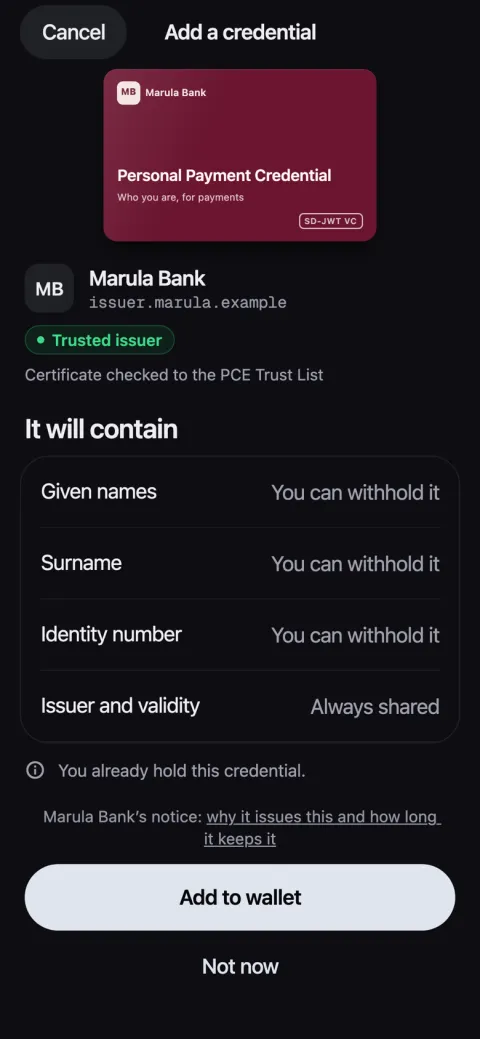
An offer
A trusted issuer offers a credential, and says which details can be withheld.
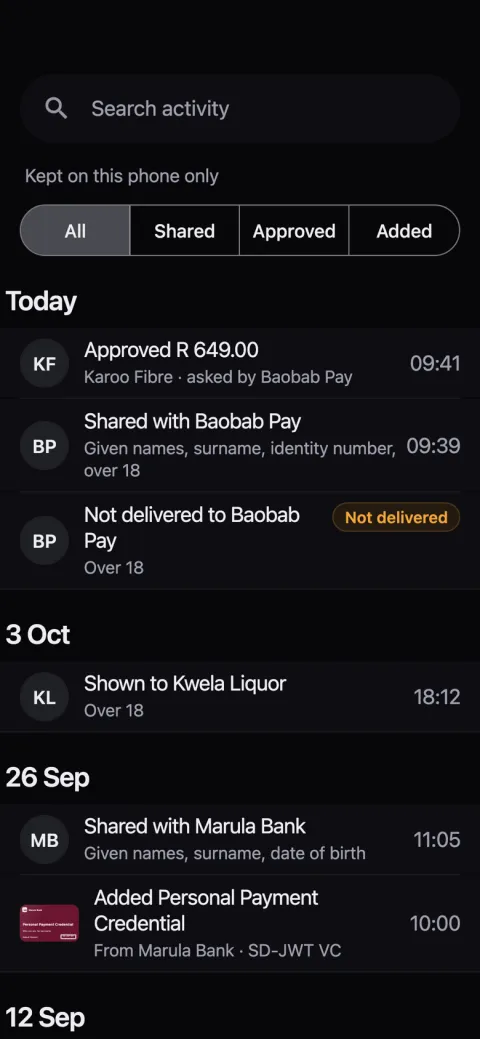
Activity
Every share and approval recorded on the phone, and nowhere else.
Vouching for the wallet, never for the person.
Before an issuer trusts a wallet, Aegis’s wallet provider checks the phone’s own attestation evidence and issues wallet and key attestations. It can suspend or revoke a compromised instance — and a wallet instance is never linked to the person who holds it.
What a business does with what it is shown.
This page is the holder’s side. Accepting a credential from any conformant wallet, a national digital identity or a mobile driving licence — and refusing whatever falls below the bar a business sets — is the verifier’s side, and has a page of its own.
Build on identity that is proven, not assumed.
Aegis is built by Protoworks and offered to partners on request. Tell us what you need to verify, issue or accept, and we will show you the platform running.